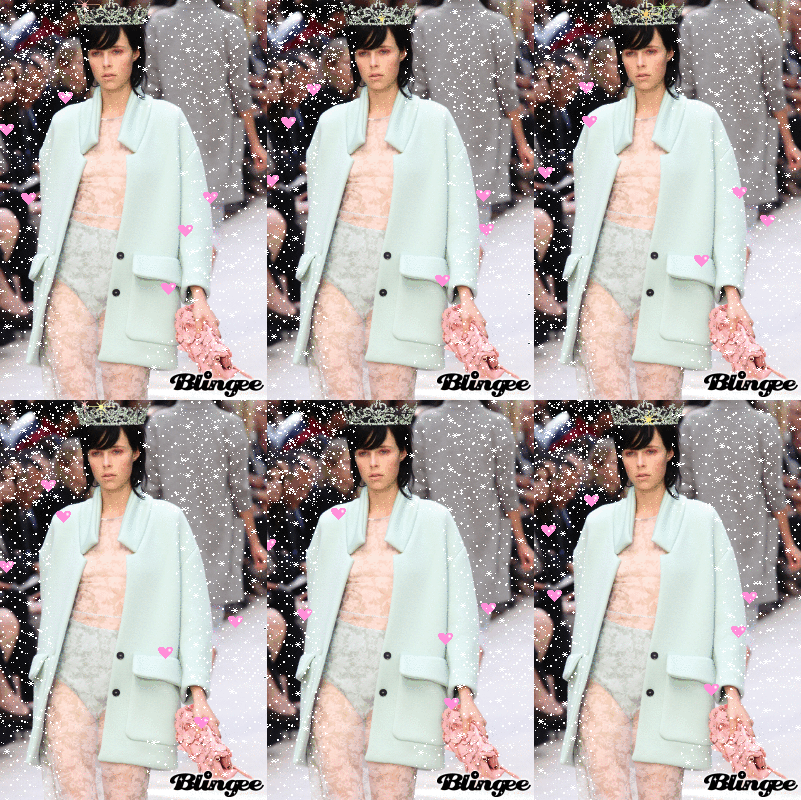
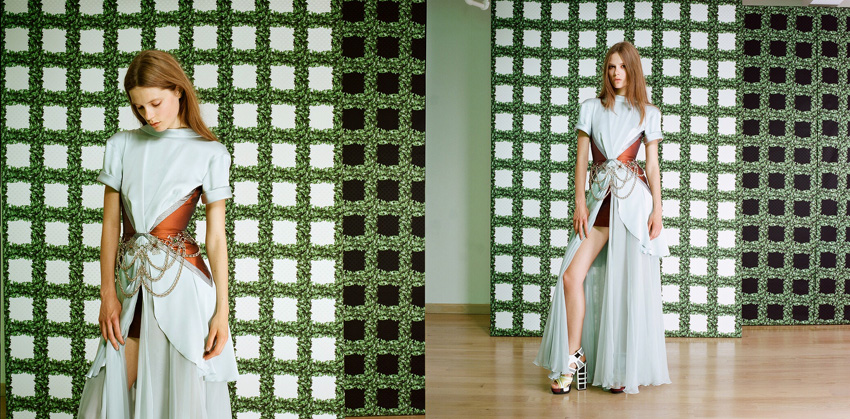
I have nothing against Karl Lagerfeld, but his short films are the absolute worst. I mean worst, and I do not say that lightly, I have seen a lot of bad stuff in my time. Having said that, there is a special kind of enjoyment in experiencing something like "Remember Now", an enjoyment akin to watching a particularly scary horror film or eating a particularly sour gummy worm. It's all about how much you can take, how long you can keep your eyes open, how long you can last. The longest I have been able to watch a Karl Lagerfeld movie straight is 2 minutes. I challenge you to beat that.
13.5.13
7.5.13
Form v Narrative
Like other art forms, film or literature or comics, fashion is a balance of both form and narrative. Obviously fashion adds function to the mix (we wear this stuff right?), but we'll ignore that element for the time being. I've already discussed on this blog how Japonisme is so hot right now, but how designers utilize this influence varies wildly, and can have a lot to do with whether the story or the form is the driving factor. Prada Spring 2013 was about the woman, somewhat of an enigma as usual, a feminist, and a Murakami heroine in spirit whose personalities were expounded on in the campaign video (which I am still watching because I am sure I am still missing something). On the other hand we have The Row, which often looks to Japan, but the Winter 2013 collection was restricted to exploring the formal properties of Japanese dress, reconstructed for the Upper East Side sensibility.
In fact The Row weren't the only ones feelin' form, Winter 2013 was a veritable feast of collections which celebrated only that which could be seen. The clothes existed on purely physical, touchable and gazeable terms, and how gloriously they did. And for a city that, in general, usually bores me, Milan did exceptionally well.
How often does MaxMara grab any critic's attention? But this season they were a mega player. The genius of MaxMara lay in the pure pleasure of browns and black and gold mixed together, of layers upon layers of fur and satin and what appeared to be luxurious polar fleece. All high concepts were absent, background stories replaced with absolute mountains of fabric draped off the body. To look through the slide show of the MaxMara collection is to feel satisfied, gratified. I can only imagine what it would have been like to see the clothes in person.
Then we had the Giambattista Valli and Francesco Scognamiglio collections which were explorations into white, fur, and white fur. I mean this stuff is the opposite of Prada, and Louis Vuitton, in the best way possible.
But if one had to pick a champion of the gloriously constructed, the absolutely straightforward, the resolutely beautiful, Hermes was it. This is a bold claim, but I'm willing to back it up.
Exhibit A: a perfect navy suit was shown not once, but six times. Here are three. When was the last time I saw a pant suit executed perfectly? I cannot remember. Maybe it was with Yves Saint Laurent, but I was not alive then.
Exhibit B: note the subtly exact use of colour. No shade of brown or browny green was shown twice, yet as a whole the collection's palette was wonderfully coherent. Side Note: even the navy suits didn't all use the same shade of navy.
Exhibit C: a part from the piping, and perfect drape, what unites these looks is that I sigh when I see them. Can I look at them forever? For once the real life clothes are as elegant as their sketches.
In fact The Row weren't the only ones feelin' form, Winter 2013 was a veritable feast of collections which celebrated only that which could be seen. The clothes existed on purely physical, touchable and gazeable terms, and how gloriously they did. And for a city that, in general, usually bores me, Milan did exceptionally well.
How often does MaxMara grab any critic's attention? But this season they were a mega player. The genius of MaxMara lay in the pure pleasure of browns and black and gold mixed together, of layers upon layers of fur and satin and what appeared to be luxurious polar fleece. All high concepts were absent, background stories replaced with absolute mountains of fabric draped off the body. To look through the slide show of the MaxMara collection is to feel satisfied, gratified. I can only imagine what it would have been like to see the clothes in person.
Then we had the Giambattista Valli and Francesco Scognamiglio collections which were explorations into white, fur, and white fur. I mean this stuff is the opposite of Prada, and Louis Vuitton, in the best way possible.
But if one had to pick a champion of the gloriously constructed, the absolutely straightforward, the resolutely beautiful, Hermes was it. This is a bold claim, but I'm willing to back it up.
Exhibit A: a perfect navy suit was shown not once, but six times. Here are three. When was the last time I saw a pant suit executed perfectly? I cannot remember. Maybe it was with Yves Saint Laurent, but I was not alive then.
Exhibit B: note the subtly exact use of colour. No shade of brown or browny green was shown twice, yet as a whole the collection's palette was wonderfully coherent. Side Note: even the navy suits didn't all use the same shade of navy.
Exhibit C: a part from the piping, and perfect drape, what unites these looks is that I sigh when I see them. Can I look at them forever? For once the real life clothes are as elegant as their sketches.
all images from vogue.com
Labels:
Francesco Scognamiglio,
Giambattista Valli,
MaxMara,
Milan,
Paris,
Prada,
Reviews,
Runway,
The Row
30.4.13
21.4.13
A Great Collection
J.W. Anderson really moved me this season. And I've had to wait a while to review the collection because it blew me away in a way I didn't understand at all. Since February I've been thinking about it every couple of days, and trying to figure out what makes it a great collection. And I really do mean great! I'm getting the same feelings I had gazing upon Christopher Kane S/S12 or Prada S/S11.
So why was J.W. Anderson so wonderful this season? Perhaps it is to do with that fact it was new in the subtlest and most fundamental sense. It did not feel new because, say, orientalism hasn't been around in a while or it rehashed minimalism or because its influences had not been cited before. It was like a seismic shift - there may not have been an earthquake but you're definitely not standing in the same spot on earth as you were a day ago.
The "newness" could lie in the way that Anderson created fresh forms. Sarah Mower reported that Anderson and his stylist "had been working on a lot of abstract techniques with fabric in the studio on Shacklewell Lane, guided only by whether the results seemed genuinely new to their eyes". Here the necklines creep up, pant legs hang as if wet, skirt hems transform into mere decorative elements, and everywhere lines of fabric were flapping and billowing in unexpected places. While explorations of form often amount to an experimental collection, unwearable in the everyday sense, Anderson hasn't compromised on the real life of the clothes, the fact that they are worn and lived in. Sure some of these looks wouldn't be seen on the street, but the majority would fit in surprisingly well. While I love a designer that pushes the limits of what clothes can be, what I admire most are those clothes that are simultaneously entirely new and entirely practical - which is rarer than you'd think.
Allusions to hospital gowns, arms strapped down by a knitted oversleeve, and lines of fabric flapping loose all conjure images of the psyche ward, emphasised by, as Maya Singer writes, "a fit of derangement" in the form of two comic-print looks. This enhances the contemporary feel, the madness is specific to the volatile teen years and so perhaps speaks to a younger audience. Indeed the deranged, visual shout of the comic-print cameo reminded me of the book by Jeff Daniels of The Mountain Goats, about a psyche ward-ridden teenager who is obsessed with Black Sabbath's Master of Reality.
Having said that, there was ultimately no straightforward narrative to this collection, no story of a girl or a city or a decade. When Maya Singer asked about the "atmosphere of lunacy" Anderson talked about the physical disruption of the clothes' construction rather than narrative - "he spoke not of reality suspension but of architectural suspension". Every review used words like "mysterious" and "puzzling" and "incomprehensible", but rather than being dismissed for being too hard, too opaque, the collection keeps one intrigued.
Before I sign off I also have to quote the last line from Maya Singer's review (man I'm quoting others a lot in this post aren't I?) because when I read it it affirmed my thoughts precisely, I wanted to ring up Singer there and then and say "yes, exactly".
"This collection was interpretable in any number of ways. But the clear takeaway was that it was captivating, original, modern, and great."
So why was J.W. Anderson so wonderful this season? Perhaps it is to do with that fact it was new in the subtlest and most fundamental sense. It did not feel new because, say, orientalism hasn't been around in a while or it rehashed minimalism or because its influences had not been cited before. It was like a seismic shift - there may not have been an earthquake but you're definitely not standing in the same spot on earth as you were a day ago.
The "newness" could lie in the way that Anderson created fresh forms. Sarah Mower reported that Anderson and his stylist "had been working on a lot of abstract techniques with fabric in the studio on Shacklewell Lane, guided only by whether the results seemed genuinely new to their eyes". Here the necklines creep up, pant legs hang as if wet, skirt hems transform into mere decorative elements, and everywhere lines of fabric were flapping and billowing in unexpected places. While explorations of form often amount to an experimental collection, unwearable in the everyday sense, Anderson hasn't compromised on the real life of the clothes, the fact that they are worn and lived in. Sure some of these looks wouldn't be seen on the street, but the majority would fit in surprisingly well. While I love a designer that pushes the limits of what clothes can be, what I admire most are those clothes that are simultaneously entirely new and entirely practical - which is rarer than you'd think.
Allusions to hospital gowns, arms strapped down by a knitted oversleeve, and lines of fabric flapping loose all conjure images of the psyche ward, emphasised by, as Maya Singer writes, "a fit of derangement" in the form of two comic-print looks. This enhances the contemporary feel, the madness is specific to the volatile teen years and so perhaps speaks to a younger audience. Indeed the deranged, visual shout of the comic-print cameo reminded me of the book by Jeff Daniels of The Mountain Goats, about a psyche ward-ridden teenager who is obsessed with Black Sabbath's Master of Reality.
Having said that, there was ultimately no straightforward narrative to this collection, no story of a girl or a city or a decade. When Maya Singer asked about the "atmosphere of lunacy" Anderson talked about the physical disruption of the clothes' construction rather than narrative - "he spoke not of reality suspension but of architectural suspension". Every review used words like "mysterious" and "puzzling" and "incomprehensible", but rather than being dismissed for being too hard, too opaque, the collection keeps one intrigued.
Before I sign off I also have to quote the last line from Maya Singer's review (man I'm quoting others a lot in this post aren't I?) because when I read it it affirmed my thoughts precisely, I wanted to ring up Singer there and then and say "yes, exactly".
"This collection was interpretable in any number of ways. But the clear takeaway was that it was captivating, original, modern, and great."
Labels:
Autumn/Winter 2013,
J.W. Anderson,
London,
Reviews,
Runway
11.4.13
Proenza and Schouler and Divola and Dance, Together
Boy, they sure ain't kidding when they say fashion moves fast. Not a month since New York Fashion Week this Document Journal editorial springs up, influenced by Proenza Schouler's F/W2013 Collection. To be precise it's not exactly influenced by the collection, but by Jack and Lazaro's own influence for the collection (which is somewhat dubiously related to the resulting clothes), photographer John Divola's Zuma series.
The menacing mood, surreal lighting, and the state of disrepair of the location have all been toned down for the editorial, but a sanitized spirit of Divola's California-in-decay still remains. In the hands of a lesser stylist the concept could have seemed derivative or gimmicky, but as usual stylist Stevie Dance manages to capture - or create - the spirit of the times while producing something that looks and feels completely unique. Dance is exceptional for her ability to make high fashion look, if not "street" exactly, less like the wardrobes of bankers'-wives and more creatively and culturally relevant - as well as oddly wearable.
Unlike those editorials which literally re-present entire looks from a collection, in the exact same spirit and narrative of their show, Dance reinvents the context and attitude of clothes so that it's harder to pinpoint which designer or collection a look comes from. Essentially Dance has unusually great creative influence for a stylist, she influences how an audience interprets clothes rather than merely offering them up for view.
But back to Divola, better not forget Zuma itself:
But referencing the Zuma series is all pretty controversial at the moment. Divola himself is a little miffed by the extent to which his work keeps "inspiring" shoots like these. Before the Zuma series was an influence for Jack and Lazaro's Winter 2013 Collection, it was directly riffed off for the Spring 2013 Campaign. So this editorial is a little stupid on Document Journal's behalf - or not of course, they could have already known about the controversy, and any press is good press yadda yadda.
Unlike those editorials which literally re-present entire looks from a collection, in the exact same spirit and narrative of their show, Dance reinvents the context and attitude of clothes so that it's harder to pinpoint which designer or collection a look comes from. Essentially Dance has unusually great creative influence for a stylist, she influences how an audience interprets clothes rather than merely offering them up for view.
But back to Divola, better not forget Zuma itself:
But referencing the Zuma series is all pretty controversial at the moment. Divola himself is a little miffed by the extent to which his work keeps "inspiring" shoots like these. Before the Zuma series was an influence for Jack and Lazaro's Winter 2013 Collection, it was directly riffed off for the Spring 2013 Campaign. So this editorial is a little stupid on Document Journal's behalf - or not of course, they could have already known about the controversy, and any press is good press yadda yadda.
Document Journal editorial from Fashion Gone Rogue
John Divola images from his website
Proenza Schouler campaign from the depths of the web
Labels:
Art,
Campaigns,
Editorials,
John Divola,
Meghan Collison,
Photography,
Proenza Schouler,
Stevie Dance
31.3.13
Shut Up and Take my Money Phil
Fashion is a unique creative art in that it has a second life as a practicality. One doesn't need to own art or books or movies to function in society, but as soon as you step outside without your clothes on you're going to get in trouble. But because clothes have two lives, as something functional and also as art or design, it can become confusing as to how they should be considered, critiqued, and to which social discussions they belong: commerce? Design? Art? The result is fashion journalism that, while rarely explicitly stating from which angle they are approaching fashion, takes a side nonetheless. Tim Blanks is my favourite writer in the fashion as design/art camp, his pieces are a joy to read in themselves and are incredibly insightful. If you want to "understand" a collection you better hope Blanks has been assigned to review it. On the other end of the spectrum are writers who list elements of the collections, usually accessories, like an inventory, and state things like "outerwear and dresses were the focus point of this collection". Major yawn inducing material.
However if I was one of those commercially minded critics, 3.1 Phillip Lim would have most definitely satisfied me. And by "commercially minded critic" I mean that outwardly I was saying things like "Lim has cleverly created a collection full of seemingly endless separates that will sit super comfortably on shop hangers and will disappear in a heartbeat", but inside I was just squealing and figuring out how many months it will be until I can price compare it all on Polyvore. I don't get this with The Row or even Proenza Schouler, which is partly because of the price point but mainly because there is something, something that I can't quite put my finger on, that is so buyable about Phillip Lim's collection. I can already see these coats and jumpers and dresses sitting on hangers and shelves so clearly. Here are some of the best looks of the collection, peruse the catalog and start your saving.
Labels:
3.1 Phillip Lim,
Autumn/Winter 2013,
New York,
Reviews,
Tim Blanks
23.3.13
Octo Style/NY-JPN
This is a post about the highlights of New York's Winter 2013 fashion week, but I'm going to backtrack a bit to Pre-Fall 2013 to set the scene. Lately at The Row, Mary-Kate and Ashley have been veering occasionally from neu-conservatism elegance into regular old octogenarian elegance. Some of these looks remind me of the final page of all those Vogue "style at any age" features. And there is nothing wrong with advanced style, but rather than the theme of radical restraint of previous The Row collections, on twenty-somethings these clothes seem stale and conservative.
So with Pre-Fall 2013 as a precursor, it was with extra interest and slight apprehension that I took in F/W 2013. In some ways the octo-style theme was continued, with subtly textured creamy gold adorning practical pants and opera-ready shawls. Literally both my grandmas had pants like that.
But in many more ways my fears that The Row had crossed the line for good, from radically conservative to conservative-conservative, were assuaged. They've taken their usual Japanese motifs to new and glorious heights, their all-navy looks wrapped by pseudo-obis, coats nipped and flaring to perfectly shape the body, or tied at the sides, and everything always in a glorious symphony of textures. Of course every designer and his dog has been feeling Japanese lately, but when it comes to the cut and unusual shapes and silhouettes, Mary-Kate and Ashley are more meticulous, more focused, and simply better.
MK and Ashley explained the collection as a mix of Victorian and Japanese dress codes, and while the Victorian element can certainly be found in the modesty of these looks, the combination was even clearer in their set design. The location was an Upper East Side townhouse, and it was decorated in a hushed-elegance sort of way with carefully mismatched antiques and Japanese floral arrangements.
And if grand themes were to be found at New York Fashion Week, an understated and very serious interpretation of elements of Japanese dress was one of them. Proenza Schouler also riffed on the obi, and the folding and wrapping of Japanese dress. The looks which utilized these elements were some of the best, and emphasized the controlled movement of the clothes, a theme that ran through the whole collection. Even the gentle curves of jacket and skirt edges were completely controlled, and moved in a kind of erratic way rather than fluidly.
Many reviews noted that this comparatively sober show was very "grown up" for Proenza Schouler, but I thought the surprised tone was unfounded. Sure Proenza Schouler is synonymous with the young, thin It Girls, but they have always shown collections with undercurrents of the prim and proper, from Spring '09 to Spring '12. Maybe I just hate this particular cliche, but if anyone else claims that Jack and Lazaro have "grown up" I'm gonna get real mad.
So with Pre-Fall 2013 as a precursor, it was with extra interest and slight apprehension that I took in F/W 2013. In some ways the octo-style theme was continued, with subtly textured creamy gold adorning practical pants and opera-ready shawls. Literally both my grandmas had pants like that.
But in many more ways my fears that The Row had crossed the line for good, from radically conservative to conservative-conservative, were assuaged. They've taken their usual Japanese motifs to new and glorious heights, their all-navy looks wrapped by pseudo-obis, coats nipped and flaring to perfectly shape the body, or tied at the sides, and everything always in a glorious symphony of textures. Of course every designer and his dog has been feeling Japanese lately, but when it comes to the cut and unusual shapes and silhouettes, Mary-Kate and Ashley are more meticulous, more focused, and simply better.
MK and Ashley explained the collection as a mix of Victorian and Japanese dress codes, and while the Victorian element can certainly be found in the modesty of these looks, the combination was even clearer in their set design. The location was an Upper East Side townhouse, and it was decorated in a hushed-elegance sort of way with carefully mismatched antiques and Japanese floral arrangements.
And if grand themes were to be found at New York Fashion Week, an understated and very serious interpretation of elements of Japanese dress was one of them. Proenza Schouler also riffed on the obi, and the folding and wrapping of Japanese dress. The looks which utilized these elements were some of the best, and emphasized the controlled movement of the clothes, a theme that ran through the whole collection. Even the gentle curves of jacket and skirt edges were completely controlled, and moved in a kind of erratic way rather than fluidly.
Many reviews noted that this comparatively sober show was very "grown up" for Proenza Schouler, but I thought the surprised tone was unfounded. Sure Proenza Schouler is synonymous with the young, thin It Girls, but they have always shown collections with undercurrents of the prim and proper, from Spring '09 to Spring '12. Maybe I just hate this particular cliche, but if anyone else claims that Jack and Lazaro have "grown up" I'm gonna get real mad.
The Row images from vogue.com
Interior image from Habitually Chic
Proenza Schouler images from vogue.com and models.com
Labels:
Autumn/Winter 2013,
New York,
Proenza Schouler,
Reviews,
Runway,
The Row
Subscribe to:
Posts (Atom)